
Dear Friend,
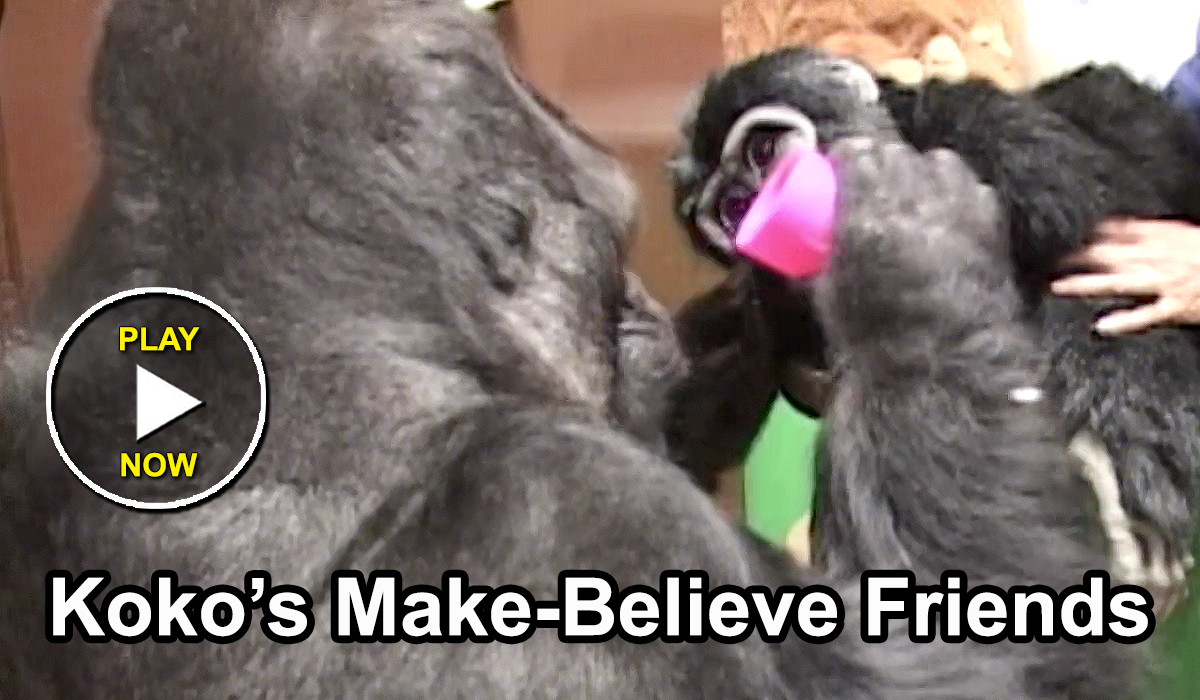
See Koko engage in behavior that looks strikingly like pretend play, with a gorilla puppet and a small baby doll (watch the above video).
In one instance, she offers water from a pink cup to the puppet. In another, she focuses on the baby doll’s hands and feet, carefully filing the doll’s nails. These clips are both from late 2001, but there are many more throughout the years.
Scenes like these were often set aside as anecdotal rather than accepted as scientific evidence of imagination in nonhuman apes. For a long time, pretend play was widely regarded as a uniquely human capacity or, at the very least, something very difficult to demonstrate clearly in another species.
That view is beginning to shift. In a recently published study in Science, a bonobo named Kanzi took part in controlled pretend scenarios involving invisible juice and grapes and successfully tracked where those imagined items were supposed to be. The findings have been described as the first clear experimental evidence of pretend play in a nonhuman.
Seen in that light, Koko’s actions feel especially noteworthy. The footage does not prove in a controlled way what she was thinking, but it does show her engaging with a puppet and doll in ways that closely resemble make-believe play.
Moments like these suggest that the capacity to imagine and pretend may not belong to humans alone.
Koko always amazed me with her abilities.
It is heartening to see research begin to catch up with what those of us who knew her had the privilege of witnessing firsthand.
This research helps people truly understand what’s at stake—and why protecting gorillas matters so deeply.
With Koko love,

Penny Patterson
President, CEO and Founder
The Gorilla Foundation / koko.org

Conservation through Communication
The Gorilla Foundation is a 501(c)(3) nonprofit organization.
Our Federal Tax ID is: 942-38-6151