





A Tribute to Jane Goodall
by Parker Daley, Communications Director
In 1987, Dr. Jane Goodall was mid-debate with her students at Gombe Stream Research Center. Dr. Goodall, having already spent decades understanding the perspectives and complex social structures of Tanzania’s wild chimpanzees, was steadfast in her conviction that students should sit or lie down while observing the animals.
When the chimps were on the ground, she argued, it would be disconcerting for them to have clipboard-wielding humans towering above. Her students disagreed; they were convinced that the chimps were so accustomed to human presence that the positioning of their human observers should not matter.
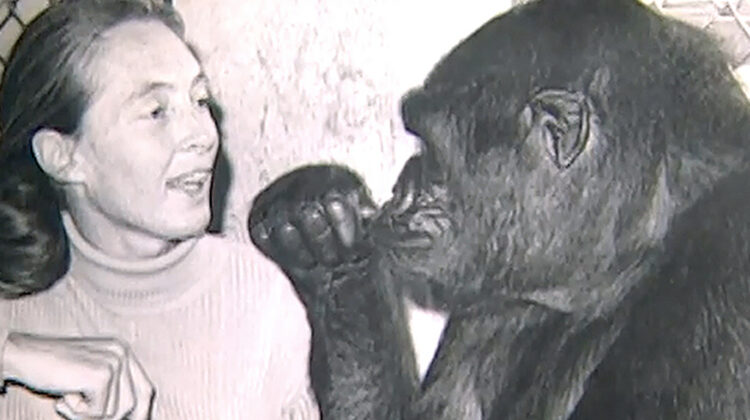
Fortunately, Dr. Goodall found the ideal judge to settle the argument: Koko the gorilla, who communicated with humans using a modified form of American Sign Language and was therefore optimally positioned to speak on behalf of the wild great apes. The verdict came back in Jane’s favor, with Koko definitively saying people should “lie down!”
In addition to validating her stance on research methods, Koko offered Dr. Goodall evidence of the individuality, complex emotional lives, sense of humor, and empathy of non-human great apes. Dr. Goodall had already observed and recorded each of these traits in the wild chimpanzees of Tanzania, but Koko confirmed these findings in a language all humans could readily understand.
In doing so, the ‘talking gorilla’ illuminated the most revolutionary aspect of Dr. Goodall’s research.
Dr. Goodall understood the chimpanzees’ complex family dynamics, witty sense of humor, compassion for one another and other animals, and strategic thinking abilities without needing it to be explicitly presented in her language.
Rather than evaluate the world from the confines of her individual, human perspective, she approached ethology in a revolutionary manner by integrating herself with the animals she was looking to understand. She did not require human words to accept the intellectual capabilities of our great ape cousins.
Dr. Goodall was the first researcher to use names, rather than numbers, when observing the animals. She watched them with an understanding of their inherent value as fellow earthlings, and with a desire to know the world from their perspective rather than a skepticism that such a perspective even existed.
She became a part of their world, spending hours assimilating to the environment around her by silently following a chimpanzee family and slowly gaining their trust.
Conversely, Koko the gorilla was raised as part of a human family. Born in the San Francisco Zoo in 1971, she was a part of our world from the start. When Dr. Francine “Penny” Patterson began teaching Koko sign language, she was once again adopting our species’ custom.
Koko and Dr. Goodall both served as a bridge between human and non-human great apes, with each acting as a voice for nature in their own way.
Dr. Patterson and Dr. Goodall’s work was similarly revolutionary in redefining the lines drawn between humans and the world around us. Their breakthroughs were enabled by a shared interest to approach animal behavior research with empathy, and a desire to understand the unique perspectives of individuals from a separate species.
For decades, researchers had attempted to define what distinguishes humans from other animals, searching for a single trait that might justify our continued exploitation of other species. Both Dr. Patterson and Dr. Goodall’s research shattered barriers that previously upheld the institutions responsible for widespread suffering in the non-human animal kingdom.
In October of 1960, Dr. Goodall watched a male chimp strip the leaves from a twig and use it to scoop termites out of a mound for food. The chimp, dubbed David Greybeard, had demonstrated that he could make and use tools, tasks previously thought to be uniquely human traits.
Dr. Goodall’s early discovery not only put her on the map as a researcher and kickstarted her PhD in ethology, but shattered a wall built between humans and our closest living relatives.
Jane’s observation was made prior to any formal training in animal behavior research, with eyes unclouded by academic institutions and human expectations of how other animals should behave. By approaching the chimpanzees of Gombe with an open mind and optimism regarding their sentience, she redefined the distance between ‘us’ and ‘them’.
Similarly, Dr. Patterson’s research with Koko was erasing the boundaries linguists and ethologists had drawn between man and ape. Koko not only mastered signs and used them in the context of her physical environment (asking for specific foods, to go for a walk, etc.) but she employed this shared language to offer her caregivers insight into her emotional life.
The most well-known examples of this were Koko’s self-reported sadness following the death of her kitten All-Ball and, a few decades later, her close friend Robin Williams.
She demonstrated her mental capacities in more joyful ways as well, through jokes and pranks, the anticipation of holidays (including lots of decoration and specific gift requests), commentary on books and television, and a lifelong passion for motherhood that manifested itself in the adoption of many kittens.
Through the shared medium of sign language — and her nurturing interactions with kittens — Koko taught Dr. Patterson as much about the inner lives and social dynamics of gorillas as Dr. Patterson taught her about human language and customs.
Gorillas naturally communicate using a combination of vocalizations and gestures, and Koko integrated her own gestural (sign) language into the American Sign Language she was taught seamlessly.
If Dr. Patterson was unsure of a word in Koko’s vocabulary, chances were it was a native gorilla gesture that she would later learn to understand! Or, it was a newly invented sign by Koko to allow her to communicate a familiar concept (for example, pointing to her knee for “need”, or combining “scratch” and “comb” into “scratch-comb” as her invented compound sign for “brush.”
Both Dr. Patterson and Dr. Goodall stand out as leaders in primatology. The success of their research can be largely explained by their unwavering belief that all life warrants respect, and their subsequent desire to meet other creatures halfway in understanding.
If we expect other species to adhere to human-centric standards for intelligence and understanding the world, we create a self-fulfilling prophecy that enables us to continue inflicting suffering on individuals with whom we have more similarities than differences.
However, if we approach the world in the manner exemplified by Dr. Goodall and Dr. Patterson, seeking to learn from another species and see the world from their eyes, we open the door to a more rich and complex understanding of every form of life. And the other animals become free to evolve in their own way, following their own natural curiosity and passion.
Dr. Goodall’s life and work was an inspiration to countless individuals globally, including Dr. Patterson. What made Dr. Goodall such a special and powerful force in this world is encapsulated by the question she asked Koko about placing herself on the same physical level with her research subjects.
Jane did not look down on the chimps from the perspective of a human scientist, but sat among them as equals to foster a connection built on a shared perspective of the world in which we all reside.
Dr. Patterson followed that model in many respects, by making Koko (and her companion gorillas Michael and Ndume) part of an interspecies family.
Note: Jane Goodall wrote a tribute to Koko, upon her passing in 2018. You can read it on her website, here.